
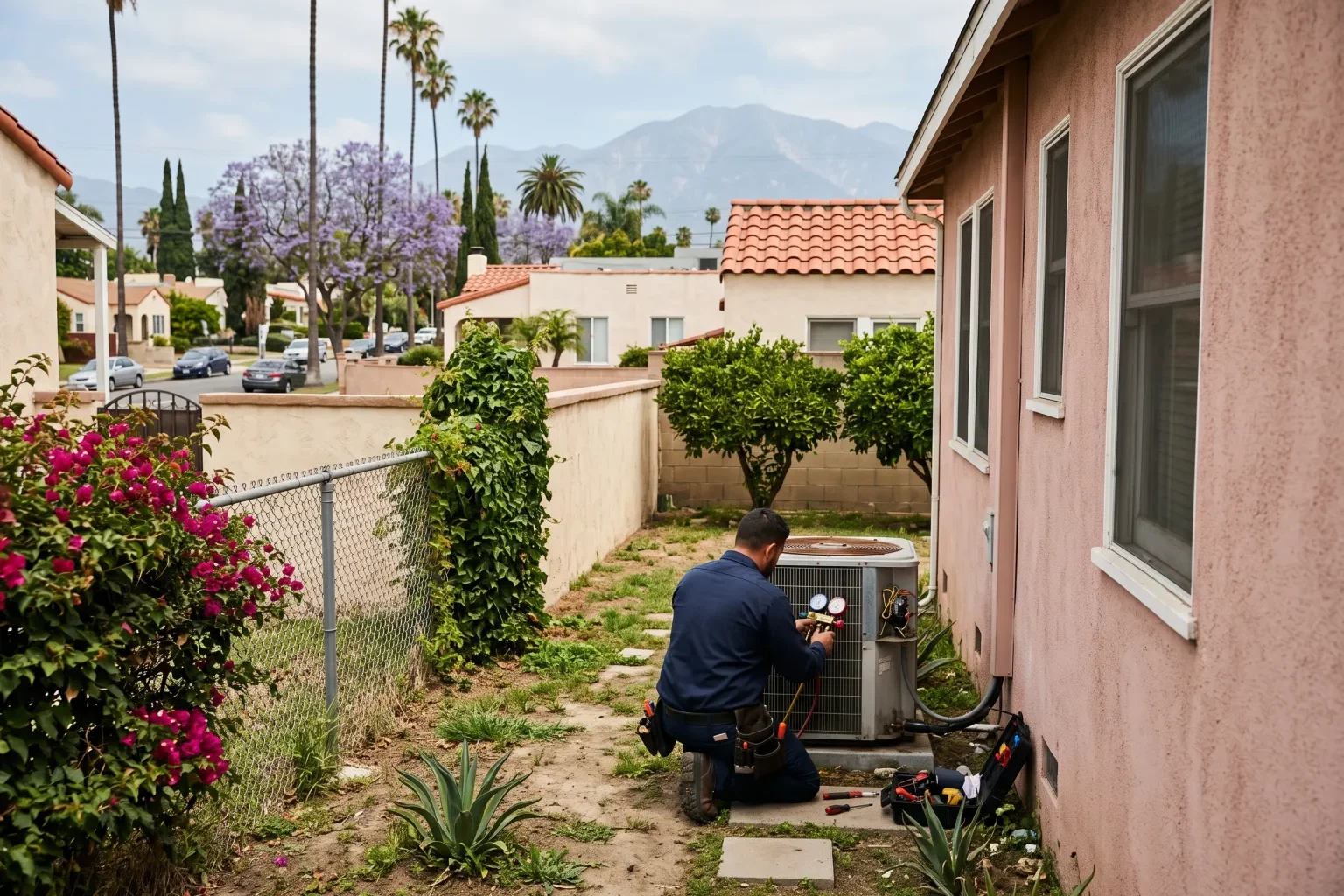
The short answer
If your AC blows warm air, runs nonstop, leaks water, ices up, trips the breaker, or makes new noises, it needs a repair visit. AirCore finds the actual cause and explains your options in plain terms. You get a price before any work begins, so you can decide whether repair or replacement makes more sense.
When your air conditioner stops keeping up, especially during a hot inland summer or a Santa Ana spell, you want a clear answer about what's wrong and what it will take to fix it. AirCore HVAC Repair Service repairs central air conditioners, heat pumps, and ductless systems for homeowners in Los Angeles and nearby cities. This page covers the warning signs worth acting on, what our technicians check during a repair visit, and how we weigh repair against replacement. It also explains what drives the cost of a job and what to expect from the moment you schedule until the system is running again.
Signs Your AC Needs Repair
Los Angeles has dry summers and mild winters, but inland neighborhoods and the valleys run much hotter than areas near the coast. Fall Santa Ana winds can also bring hot, dry spells late in the season. That means many systems work hardest from midsummer into fall, and small problems often show up then. Schedule service if you notice any of the following:
If you smell burning or the breaker trips repeatedly, turn the system off at the thermostat and leave it off until it's inspected. Running it can turn a smaller electrical problem into a larger one.
- Air from the vents feels warm or only slightly cool
- The system runs constantly but the house never reaches the thermostat setting
- Some rooms are much warmer than others when they used to be even
- The outdoor unit hums but the fan doesn't spin, or the unit won't start at all
- The breaker trips when the AC turns on
- Ice forms on the refrigerant lines or the indoor coil
- Water pools around the indoor unit, or a ceiling stain appears under an attic air handler
- Grinding, squealing, banging, or rapid clicking sounds
- Burning, musty, or chemical smells from the vents
- Short cycling, where the system turns on and off every few minutes
- Electric bills climb without any change in how you use the system
What We Check During a Repair Visit
A good repair starts with finding the actual cause, not just treating the symptom. Warm air, for example, can come from a failed capacitor, a dirty condenser coil, a refrigerant leak, a clogged filter, or a thermostat problem. Our technicians work through the system in a consistent order so nothing gets skipped.
We explain what we found in plain terms and show you the failed part or problem area when we can. We also tell you which issues need attention now and which can wait.
- Thermostat settings, wiring, and batteries
- Air filter condition and airflow at the return and supply vents
- Electrical connections, contactor, capacitors, and fuses or breakers
- Outdoor condenser coil, fan motor, and fan blade
- Compressor operation and electrical draw
- Refrigerant pressures and temperatures, with a leak search if the charge is low
- Indoor evaporator coil, blower motor, and blower wheel
- Condensate drain line, drain pan, and safety float switch
- Visible ductwork in attics, crawlspaces, or garages, checked for disconnected or crushed sections
Repair or Replace?
Most AC problems are repairable, and we don't push replacement when a repair makes sense. A bad capacitor, contactor, drain clog, or fan motor is usually a straightforward fix on an otherwise healthy system. Replacement becomes worth discussing in a few situations: the compressor has failed on an older unit, the coil keeps leaking, the system uses an older refrigerant that's getting harder to source, or repairs are adding up year after year.
To help you decide, we'll talk through the age and overall condition of the equipment and how well it has kept your home comfortable. We'll also compare the cost of the repair with the life left in the system and ask how long you plan to stay in the home.
If replacement is on the table, a heat pump is one option, since it handles both cooling and heating. LADWP residential electric customers can apply for rebates on qualifying heat pump systems, with the amount based on the unit's efficiency rating. The application is filed after the equipment is purchased and installed, within 12 months of purchase. Many homes outside the City of Los Angeles are served by Southern California Edison instead, so the rebates available to you depend on which utility serves your address. We confirm the current offer before including it in a quote. Also note that the federal tax credit for heat pumps covered only systems placed in service before December 31, 2025. It is not available for new installations after that date.
If you're also considering replacing a gas furnace, check the rules first. South Coast AQMD Rule 1111 limits NOx emissions from natural-gas central furnaces sold and installed in this region, and the district has been amending it toward zero-emission requirements. The district sets and revises the compliance dates, so review the current rule before deciding. We can walk you through how it affects your options.
What Affects the Cost of AC Repair
We give you a price before starting any repair work. We can't quote a number without seeing the system, because the same symptom can have very different causes. These are the main factors that affect what a repair costs:
Regular maintenance helps keep repairs smaller. Clean coils, a fresh filter, and a clear drain line go a long way, and a maintenance visit can catch worn parts before they fail on a hot day.
- The part that failed, since a capacitor is a very different job from a compressor or a coil
- The refrigerant type and amount needed, and whether a leak has to be found and fixed first
- The equipment brand and how easy its parts are to get
- Access, since rooftop units, tight attics, and crawlspaces take more time and care
- Secondary damage, such as a motor burned out by a failed capacitor
- Timing, if you need service outside regular hours
How an AC Repair Visit Works
Here's what to expect when you schedule an AC repair with us.
If a part has to be ordered, we'll tell you how long it should take. We'll also let you know whether a safe temporary fix can get you some cooling in the meantime.
- Scheduling: Tell us what the system is doing, when the problem started, and the type of equipment if you know it. We'll set an arrival window.
- Arrival: The technician asks a few questions about the problem, then looks at the thermostat and the indoor and outdoor equipment.
- Diagnosis: We test the system and identify the cause.
- Options and price: We explain what's wrong, lay out your options, and give you the price for each before any work begins.
- Repair: With your approval, we make the repair. This often happens on the same visit if the part is on the truck.
- Testing and cleanup: We run the system, confirm it's cooling properly, and clean up the work area.